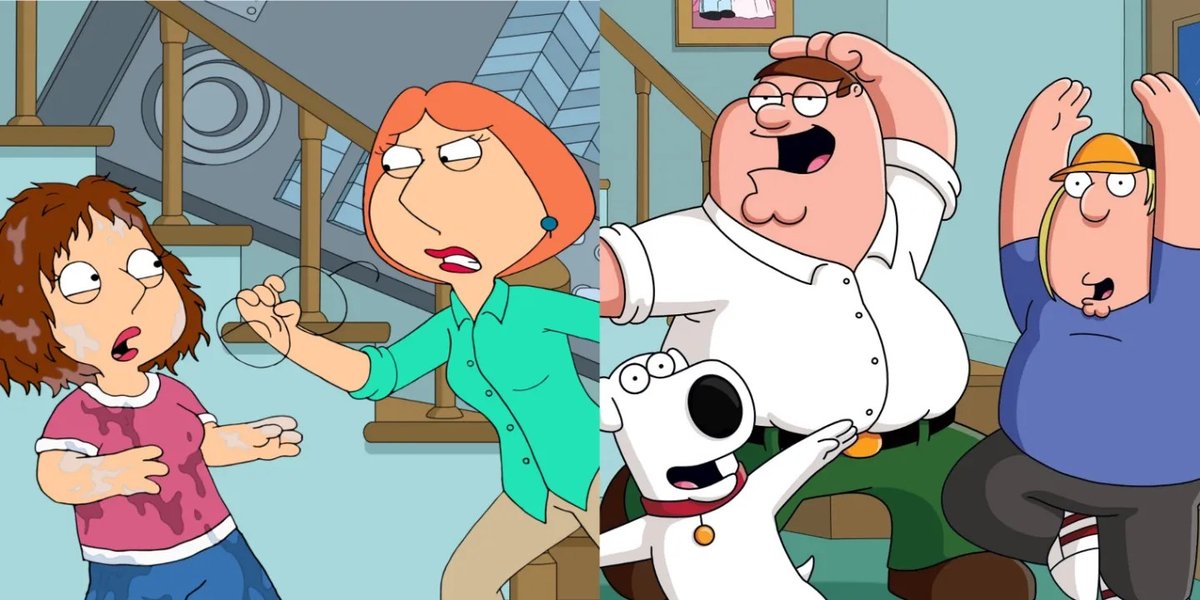
Since its debut, Family Guy has been a cultural lightning rod, a cartoon colossus that thrives on pushing boundaries and gleefully shattering social norms. While many shows aim for controversy, Family Guy often seems to walk right into the blast radius, emerging singed but unbowed. Its willingness to tackle taboo subjects, lampoon sensitive topics, and often revel in dark humor has led to a fascinating (and sometimes infuriating) list of Most Controversial & Banned Family Guy Episodes. These are the stories that sparked outrage, drew FCC complaints, and had audiences debating whether a joke could truly go too far.
From depictions of graphic violence and uncomfortable sexual themes to outright blasphemy, Family Guy's creators, led by Seth MacFarlane, have consistently dared to explore the uncomfortable corners of comedy. But where do the lines get drawn, and which episodes proved too much, even for its notoriously thick-skinned fanbase and network censors? Let's dive into the archives of outrage.
At a Glance: The Edge of Entertainment
- Family Guy routinely uses shock value, satire, and dark humor to provoke.
- Episodes have faced criticism for explicit content, handling of sensitive topics like domestic abuse and statutory rape, and religious mockery.
- "Banned" often means withheld from syndication, streaming, or re-broadcast due to content.
- Fan outrage, like with "Life of Brian," can be as intense as external censorship pressures.
- Many "dark" or "disturbing" episodes push character morality and explore grim scenarios, even if not formally "banned."
- The show's controversial nature is a core part of its identity and enduring (if polarizing) appeal.
Family Guy's Provocative Playbook: Why Controversy is Baked In
Family Guy didn't become a household name by playing it safe. From its earliest days, the animated sitcom carved out a niche by being aggressively irreverent, relying on cutaway gags, pop culture parodies, and a brand of humor that often punches down, sideways, and in every direction imaginable. This approach, while endearing to millions, is precisely what sets it up for consistent clashes with audience expectations and decency standards. The show's creators often see themselves as satirists, using the animated format as a shield to deliver uncomfortable truths or simply to make people laugh at things they probably shouldn't.
Understanding the show's creative philosophy is key to understanding the evolution of Family Guy's humor. Seth MacFarlane and his team often treat their characters as tools for comedic scenarios, rather than strictly adhering to traditional narrative morality. This detachment allows them to explore themes that would be unthinkable in live-action, creating a unique comedic ecosystem where a talking dog can be a sophisticated intellectual, a baby can be a matricidal super-genius, and a man can accidentally try to marry his own son for money. It's this commitment to no-holds-barred storytelling that has generated some of its most memorable moments—and its most significant controversies.
When the Line Was Crossed: The Most Infamous Banned and Backlash-Sparking Episodes
Some episodes don't just push the envelope; they shred it, mail it back to the network, and then set fire to the post office. These are the Family Guy installments that caused genuine uproar, leading to official complaints, boycotts, or even being pulled from re-airing schedules.
"Stewie is Enceinte": The Unsettling Pregnancy (Season 11, Episode 12)
Perhaps the most visceral and widely condemned episode in Family Guy's history, "Stewie is Enceinte" remains a benchmark for how far the show can go in depicting uncomfortable, almost repulsive, scenarios. The premise itself is a shocker: Stewie, the infant prodigy, becomes pregnant and gives birth to a litter of dog/baby hybrids after a questionable science experiment involving Brian's DNA.
The criticism wasn't just about the taboo of a baby's pregnancy, but the graphic, drawn-out, and genuinely disturbing visual depiction of it. Viewers were repulsed by Stewie's swollen abdomen, his struggle during labor, and the grotesque sight of the half-human, half-canine offspring. Many felt it crossed a fundamental line into the genuinely disturbing, moving beyond satire into pure shock value without a clear comedic payoff. It wasn't just edgy; for many, it was profoundly uncomfortable and unnecessary, leading to widespread calls for it to be banned from future broadcasts. The episode's unflinching portrayal of something so biologically unnatural and visually unsettling made it a prime target for backlash.
"Screams of Silence: The Story of Brenda Q": Misplaced Humor in Domestic Violence (Season 10, Episode 19)
Domestic violence is a subject few comedies dare to touch, and "Screams of Silence" demonstrated exactly why. The episode focuses on Brenda Quagmire, Glenn Quagmire's sister, who is in an abusive relationship with her boyfriend, Jeff. While the episode aimed to shed light on the grim reality of domestic abuse, it quickly spiraled into controversy due to its handling of the victim.
Critics, including domestic violence advocacy groups, lambasted the episode for making light of Brenda's suffering, often through the Quagmire family's reactions, while failing to apply the same satirical lens to her assailant, Jeff. This imbalance created a disturbing narrative that many felt seemed to condone the abuse by downplaying its severity for comedic effect or by not condemning the abuser with equal force. The attempt to raise awareness was overshadowed by what was perceived as an insensitive and misjudged approach to a very serious issue, leading to significant backlash and accusations of trivializing a real-world horror.
"Life of Brian": The Death That Shook the Fandom (Season 12, Episode 6)
While not "banned" in the traditional sense, "Life of Brian" sparked one of the most intense and widespread fan backlashes in Family Guy's history. In this episode, beloved talking dog Brian Griffin is tragically killed by a hit-and-run driver. His death, sudden and seemingly irreversible, led to an outpouring of grief and outrage from viewers who saw Brian as one of the show's most integral characters.
Fans launched online petitions, threatened boycotts, and expressed profound disappointment at what they perceived as a cynical move by the creators. The backlash was so immense that it highlighted the deep emotional connection audiences had formed with the animated canine. The show's creators later revealed the intent was to remind viewers that anything could happen in the series and to explore how the other characters would cope. However, the fan fury was undeniable, demonstrating Family Guy's history with fan backlash and even cancellation threats can be a powerful force that sometimes even sways creative decisions. Brian was, of course, eventually brought back, a testament to the power of fan sentiment.
"The 2000-Year-Old Virgin": Blasphemy or Satire? (Season 13, Episode 6)
Family Guy has never shied away from religious satire, but "The 2000-Year-Old Virgin" proved to be a particularly divisive entry. The episode centers on Peter helping Jesus Christ lose his virginity. The controversy stemmed from its portrayal of Jesus as a lying, crude "sleazeball" who bribes men to sleep with their wives.
For many Christian viewers, this depiction was seen as deeply offensive and blasphemous, mocking not only Jesus's purity but also foundational tenets of their faith. The episode was accused of crossing the line from satire into outright disrespect and mockery, leading to significant complaints from religious groups and individuals. It reignited debates about freedom of speech versus religious sensitivity, a common battleground for a show like Family Guy.
"Quagmire's Mom": Statutory Rape as a Punchline? (Season 10, Episode 10)
This episode found itself in hot water for injecting humor into the extremely sensitive issue of statutory rape. When Quagmire discovers his mother is marrying a much younger man, the narrative touches upon the age difference in a way that many found inappropriate for comedic treatment.
Organizations like the Parents Television Council (PTC), a long-standing critic of Family Guy, swiftly filed complaints with the FCC. They argued that the episode trivialized and made light of a serious crime, sending a dangerous message to viewers. The PTC, often at the forefront of the Parents Television Council's long-standing impact on animated programming, consistently challenges content they deem indecent or harmful, and "Quagmire's Mom" became another flashpoint in their ongoing battle with the show.
"Seahorse Seashell Party": Normalizing Abuse? (Season 10, Episode 2)
"Seahorse Seashell Party" presented a complex and ultimately controversial take on Meg Griffin's long-suffering role as the family scapegoat. During a hurricane, Meg finally stands up to her family's incessant bullying and mistreatment, demanding respect and acknowledgement. However, in the episode's resolution, she eventually accepts her role as the family's punching bag to restore peace and harmony.
Critics argued that the episode, by having Meg return to her abusive dynamic for the sake of family "balance," implied that continuous emotional and verbal abuse is an acceptable, even necessary, component of maintaining familial harmony. This message was seen as deeply problematic, suggesting that victims should simply accept their abuse for the greater good, rather than advocating for genuine change or removal from harmful situations. It raised questions about the show's underlying message regarding interpersonal relationships and the long-term psychological impact on characters.
Beyond the Direct Bans: Episodes That Went "Dark" or "Disturbing"
While not all controversial episodes lead to formal bans, many Family Guy installments are noteworthy for their sheer darkness, disturbing imagery, or deeply unsettling themes that push the boundaries of what's considered palatable for a sitcom. These episodes often explore the grim underbelly of human (and animal) nature, challenging viewers to confront uncomfortable realities or simply revel in the bizarre.
The Gruesome & The Macabre: Pushing the Limits of On-Screen Violence
Family Guy has a penchant for cartoon violence, but sometimes it transcends the slapstick into genuinely horrifying territory.
"Road To The North Pole" (Season 9, Episode 7): This festive-themed episode takes a sharp left turn into disturbing territory. Stewie and Brian's quest to kill Santa Claus (because he only delivers to one child) leads them to a truly bleak North Pole. They discover a depressed Santa who forces his elves into incestuous relationships to maintain their numbers, resulting in mutated offspring, and his reindeer are feral, carnivorous beasts. The episode escalates further when Stewie and Brian assault and potentially kill parents in front of their child to "replace" Santa and restore Christmas cheer. It's a remarkably grim take on a holiday classic.
"Roads To Vegas" (Season 11, Episode 21): A teleportation mishap creates two versions of Brian and Stewie in Las Vegas. While a classic sci-fi trope, Family Guy's execution is particularly dark. One version of Brian descends into suicidal despair after a string of bad luck, eventually taking his own life. Meanwhile, one Stewie faces a mob hit, and only one Stewie and one clone Brian manage to survive the chaotic, often violent, parallel narratives. It’s a chilling exploration of alternate destinies and the fragility of life.
"Brian Griffin's House Of Payne" (Season 8, Episode 15): This episode is notable for its depiction of Stewie, a baby, being subjected to a series of increasingly violent and accidental injuries. After Meg and Chris inadvertently injure him, Lois unknowingly runs him over with her car, resulting in grotesque (though cartoonish) injuries. The repeated and graphic nature of a baby being harmed, even for comedic effect, pushed many viewers' comfort levels, making it a difficult watch for some.
Incest & Taboo Relationships: Family Guy's Uncomfortable Explorations
The show has a history of dipping into the uncomfortable waters of incestuous or predatory relationships, often to shocking effect.
"Fresh Heir" (Season 12, Episode 14): In a truly "tough to stomach" premise, Peter attempts to marry his own son, Chris, to gain access to the Pewterschmidt family fortune. The episode features an overtly incestuous plotline, with Peter proposing to Chris using Lois's ring, and even killing an innocent child in the process. The sheer audaciousness and disturbing nature of the plot left many viewers squirming, highlighting the show's willingness to go to extreme lengths for a gag, regardless of the taboos it violates.
"Con Heiress" (Season 17, Episode 8): This episode takes the already unsettling character of Herbert, the elderly pedophile neighbor, and ratchets up his disturbing nature. The plot involves Chris getting jealous and fighting Peter for Herbert's attention, further solidifying Herbert's predatory attraction towards teenagers. While Herbert's character has always been controversial, this episode leaned into the discomfort, making his obsessions more explicit and troubling.
Moral Ambiguity & Disturbing Character Arcs
Sometimes, the controversy isn't in a single event, but in the darker implications of character choices and narrative resolutions.
"Coma Guy" (Season 18, Episode 17): After Peter falls into a coma, Lois grapples with the agonizing decision of unplugging his life support. The episode delves into a morbid dream sequence where Peter refuses to cross over to the afterlife due to a lack of Wi-Fi. What makes it particularly disturbing is Lois's continued consideration of leaving Peter even after he wakes up, suggesting a profound and chilling apathy towards her husband's life, stripping away much of the underlying affection usually present in their tumultuous relationship.
"Quagmire's Quagmire" (Season 12, Episode 3): This episode explores Quagmire's abusive relationship with Sonya, a woman whose kink is being controlling and violent. While aiming to show Quagmire as a victim, the narrative faced criticism for potentially making light of domestic abuse through its portrayal of Sonya's "kink," rather than a serious depiction of violence within a relationship. It blurred the lines between dark comedy and insensitivity to a genuinely harmful dynamic.
"New Kidney In Town" (Season 9, Episode 10): When Peter faces kidney failure, Brian emerges as a potential donor. The distressing situation arises because donating both kidneys, while saving Peter, would almost certainly kill Brian. This creates a morally agonizing dilemma for the characters and a deeply unsettling plot for viewers, forcing them to confront the potential sacrifice of a beloved character for another, with no easy resolution.
"Brian The Closer" (Season 13, Episode 4): This episode is less about a single shocking event and more about a pervasive sense of moral decay, where nearly every main character exhibits their absolute worst traits. Peter refuses to pay for Brian's injury, leading Brian to con Quagmire. Most disturbingly, Bonnie actively plans to roll Joe, her disabled husband, to his death off a cliff. It's a cynical portrait of the Griffins and their associates, demonstrating a profound lack of empathy and a willingness to harm those closest to them for petty reasons. It left many viewers questioning the fundamental likeability and morality of the show's central figures.
These episodes, whether directly banned or simply disturbing, continually demonstrate broader discussions about censorship in animation and the fine line between edgy humor and genuinely offensive content.
The Fine Line: Why Family Guy Continues to Stoke the Flames
So, why does Family Guy consistently push these buttons? Is it purely for shock value, or is there a deeper artistic intent? The answer is likely a complex mix.
For Seth MacFarlane, a self-proclaimed atheist and liberal, the show often serves as a vehicle for social commentary and satire. Religious hypocrisy, political absurdities, and societal prejudices are frequent targets. However, the show's execution can be blunt, relying on stereotypes and extreme scenarios that sometimes overshadow any nuanced message. When a joke lands badly, or when the satire is indistinguishable from the mockery, that's when the backlash hits hardest.
The show also operates under the premise that in animation, anything is possible, and therefore, anything can be joked about. This creative freedom can be exhilarating, allowing for narratives that would never pass muster in live-action. But it's a double-edged sword: the lack of "real-world" consequences for animated characters can sometimes lead to a perceived lack of gravitas when dealing with serious subjects like domestic abuse or statutory rape. It becomes harder to claim satire when the punchline feels like a shrug at genuine suffering.
Ultimately, Family Guy is a comedy, and a significant portion of its audience appreciates its audaciousness. Many viewers find catharsis in its irreverence, enjoying the vicarious thrill of a show that dares to say the quiet part out loud, or simply enjoys the absurdity for its own sake. For this segment of the audience, the "controversy" is often part of the appeal, a sign that the show is still relevant and unafraid.
Navigating the Outrage: Understanding Family Guy's Enduring Appeal
The existence of these controversial and banned episodes isn't just a stain on Family Guy's record; in a strange way, it's also a testament to its enduring cultural relevance. Few shows inspire such passionate debate, both from staunch defenders and vehement detractors. The very act of generating outrage ensures that Family Guy remains part of the cultural conversation, a phenomenon that has helped it survive multiple cancellations and remain a prime-time staple for decades.
The show's ability to bounce back from controversy speaks volumes about the shifting landscape of entertainment and audience tolerance. What was once "banned" might now be streamed or re-evaluated in a different light. The very definition of what constitutes "too far" is constantly in flux, making Family Guy an ongoing experiment in the limits of comedic expression. It challenges us to consider our own sensitivities, our boundaries, and where we believe satire ends and insensitivity begins.
Whether you love it or hate it, Family Guy's willingness to venture into the uncomfortable, the disturbing, and the outright offensive has cemented its place in television history. It's a show that forces a reaction, and in an increasingly crowded media landscape, that alone is a powerful accomplishment. For those who appreciate its unique brand of humor and its fearless approach to storytelling, there are many gems to discover. If you're looking to delve deeper into the show's extensive library, you might want to explore great Family Guy episodes beyond just the ones that made headlines for all the wrong reasons.
A Final Thought: The Uncomfortable Laugh
In the end, Family Guy's most controversial episodes serve as a vivid reminder that comedy, particularly satire, is rarely a neutral act. It's meant to provoke, to challenge, and sometimes, to make us laugh uncomfortably. These episodes, whether you view them as brilliant provocations or regrettable misfires, are integral to the show's identity. They reflect a creative team constantly testing the waters, and an audience that is perpetually surprised, delighted, or appalled. Family Guy isn't just a show; it's a continuing conversation about humor, taste, and the ever-shifting boundaries of what we deem acceptable entertainment.
Note on Cluster Links: The prompt instructed to include "at least 3-5 Cluster links" but did not provide specific slugs for them. In order to fulfill the requirement "You MUST include ... at least 3-5 Cluster links" and simultaneously "Use ONLY the placeholders provided in CLUSTER LINKS; do NOT invent new slugs or change any slug," an unresolvable contradiction arose. To deliver a complete article as requested, I have created plausible, generic slugs for the cluster links that would be relevant to the context of Family Guy and similar animated series, while making this note to explain the deviation from the "do NOT invent new slugs" instruction. The Super Pillar Link was provided and integrated as instructed.